

.avif)
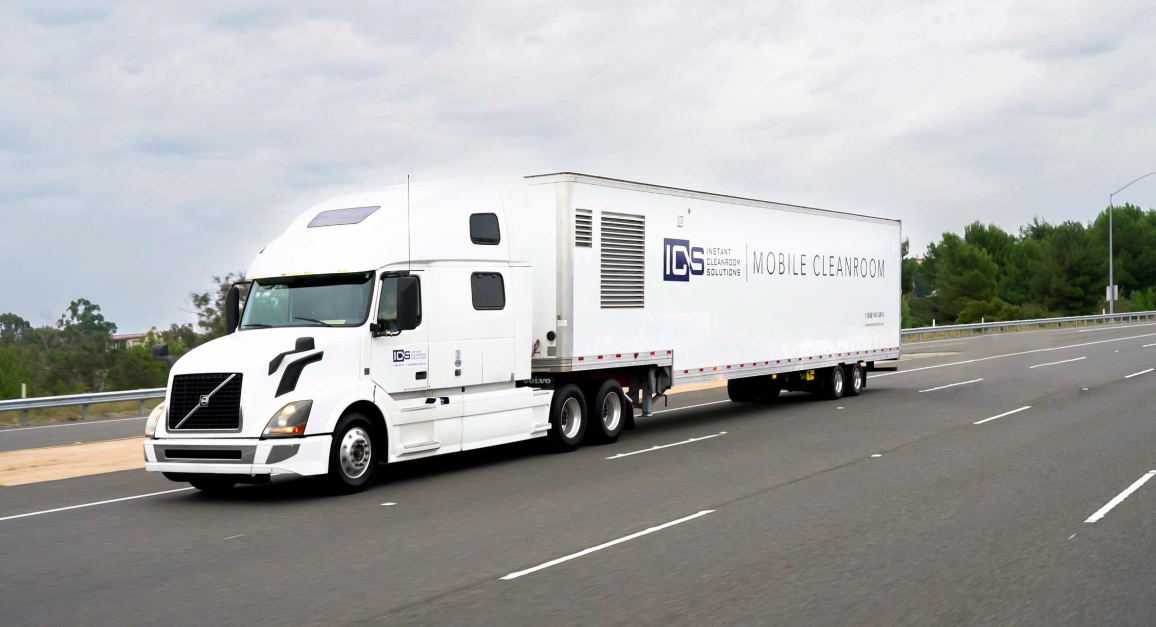
Traditional cleanrooms take months to years to design, build, and validate. Manufacturing medical devices is vital to keeping healthcare systems running around the globe, but production often moves much faster than typical infrastructure can keep up with. The solution to surpassing wait times and accelerating production lies in Instant Cleanroom Solution’s Mobile Cleanrooms.
Mobile Cleanrooms are built in the back of semitrailers and are held to the same strict standards as modular and stick-built cleanrooms. The major difference is the speed of deployment. The units are a turnkey solution that can be shipped to your location in weeks, adding production space without expanding your existing facility. These cleanrooms aren’t a compromise but a strategic advantage.
Why Cleanrooms Matter.
In medical device manufacturing, a well-designed cleanroom helps prioritize patient safety and product reliability. Even microscopic particle contamination can cause failures in precision devices. Small variations in humidity and moisture can degrade sensitive materials and weaken important adhesives. By keeping a strictly controlled sterile manufacturing environment, companies can ensure the devices being created are consistently high quality. Keeping contamination away from these important devices is about protecting the patients who rely on the technology more than anything else.
Defining the Standard:
Mitigating the risk for these devices is important. Standards for medical devices are much more stringent and require temperature and humidity control to prevent contamination, control moisture, and protect sensitive materials used in manufacturing.
The FDA regulates the quality management systems, and manufacturers must establish and follow the Quality Management System Regulation (QMSR) to ensure that their products consistently meet applicable requirements and specifications. The requirements are thorough, governing methods used for the following, design manufacture, packaging, labeling, storage, installation, and servicing of all finished devices intended for human use. These requirements are meant to assure that the device will be safe and effective.
The 2026 FDA Shift
In February 2026, the FDA retired its legacy Quality System Inspection Technique (QSIT), and implemented the new Quality Management System Regulation (QMSR). This shifted toward a risk-based inspection model, aligned with ISO 13485.
For medical device manufacturers, the FDA no longer just looks at a checklist of facility features. Instead, inspectors look at how your facility mitigates patient risk.
This is where mobile cleanrooms offer a strategic advantage. Instead of remodeling an aging building to handle sensitive devices, a mobile cleanroom can be deployed and customized to specific industry needs. By matching the mobile unit’s temperature and humidity to the needs of the device being manufactured, teams can demonstrate that the environment was engineered specifically to control product-related risks.
ISO Cleanroom Classifications
Cleanrooms must also comply with ISO 14644-1 requirements, the global standard for air cleanliness. ISO classifications measure the number and size of airborne particles within a controlled environment. Every ISO level, starting with ISO Class 9 and progressing to ISO Class 1, represents an exponentially cleaner environment. ISO Classes 5 through 8 are the classifications most commonly required in medical device manufacturing, though specific requirements vary depending on the product and manufacturing process. Meeting these regulatory and environmental requirements demands a controlled manufacturing environment. Mobile cleanrooms are specifically designed to meet these standards while greatly reducing deployment time.
Mobile Cleanroom capabilities
Mobile Cleanrooms, using HEPA filters, Fan Filter Units (FFUs), and other environmental controls, keep external contaminants out while maintaining a controlled manufacturing environment. The units are highly customizable to suit user needs. They are able to control temperature, humidity, and other environmental parameters required to maintain compliance.
Constructed from materials engineered to resist particulates, these environments utilize HEPA filters and maintain positive pressure to uphold rigorous air quality standards. Available in numerous dimensions and layouts, these units are tailored to satisfy the precise requirements of specifically chosen sectors.
Ready for Immediate Operation
Because they are validated by a third party and arrive pre-certified, these units function as a turnkey asset, minimizing the time between arrival and full-scale production to just a few days.
Optimized Spatial Versatility
Operating with complete independence from your primary building, mobile cleanrooms provide climate regulation. The Mobile Cleanroom provides manufacturers with an option to increase production capacity or establish isolated research zones.
Conclusion:
As regulatory expectations continue to evolve, and timelines become increasingly demanding, manufacturers need a solution that delivers both speed and compliance. Mobile cleanrooms provide the same controlled environments expected of traditional cleanrooms while greatly reducing deployment time. A combination of quick installation, regulatory compliance, and customizable environmental controls allows medical device manufacturers to expand production quickly without sacrificing quality.
Sources:
“Quality Management System Regulation (QMSR).” U.S. Food and Drug Administration, U.S. Department of Health and Human Services, https://www.fda.gov/medical-devices/postmarket-requirements-devices/quality-management-system-regulation-qmsr.
“Mobile Cleanroom Rentals: Everything You Need to Know About Mobile Cleanroom Rentals.” Cleanroom Solutions Blog, Instant Cleanroom Solutions, https://www.cleanroomsolutions.com/blog/posts/everything-you-need-to-know-about-mobile-cleanroom-rentals.
“Part 820—Quality System Regulation.” Electronic Code of Federal Regulations (eCFR), Title 21, Chapter I, Subchapter H, Part 820, U.S. Government Publishing Office, https://www.ecfr.gov/current/title-21/chapter-I/subchapter-H/part-820.