

The Responsibility of FFUs in Cleanrooms
What is an FFU:
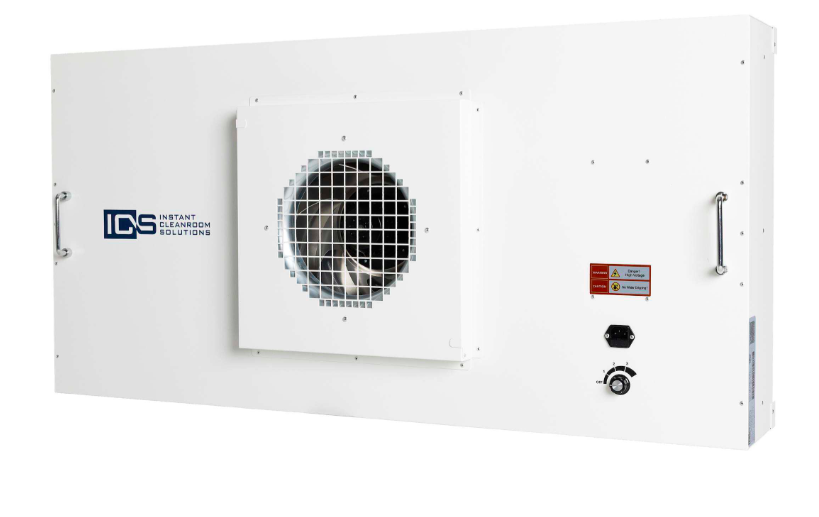
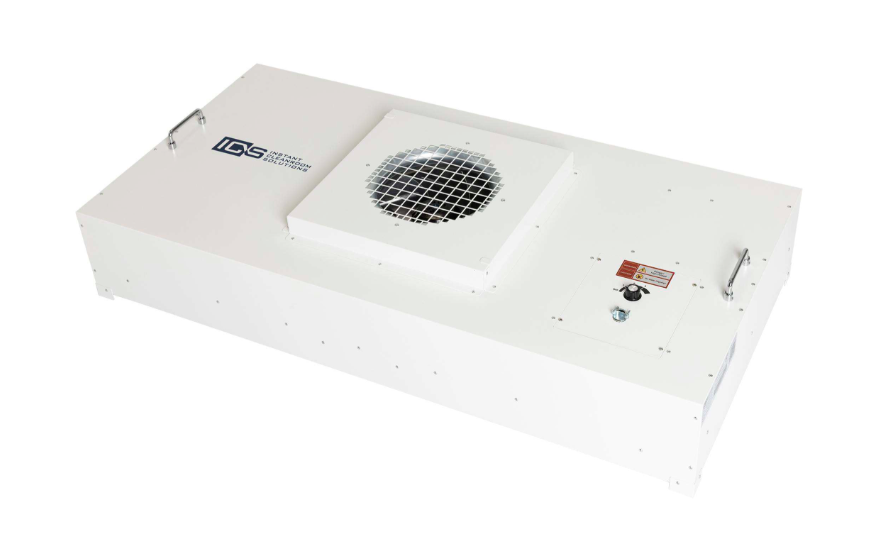
A fan filter unit (FFU) is a filtered laminar flow diffuser with its own integrated motor and fan. While passive filters rely on a central HVAC system to push air, an FFU’s motor provides enough static pressure to force air through dense HEPA or ULPA filters on its own.
What is the Primary Purpose:
An FFU’s main job is to constantly replace contaminated air with clean air. The unit pulls in unpurified air from the surrounding environment and pushes it through the filtration media. During this process, the filter strips out dust, bacteria, aerosols, and other microscopic contaminants. Finally, the FFU blows the newly purified air back into the room to meet the required ISO classifications and protect sensitive work.
How FFUs Control ISO Classifications (Air Changes Per Hour):
ACH (or Air Changes Per Hour) is a measure of how many times the entire volume of air in a space is replaced with new air. Calculating this is important when determining if a space is getting proper ventilation. ACH helps you determine what kind of device to use in a cleanroom space, along with how many should be used. The two important numbers in calculating ACH are the volume of air in CFM (cubic feet per minute) currently delivered to the room, and the volume of the room itself. Instant Cleanroom Solutions’ FFUs are about 500 CFM.
The formula for finding Air Changes per Hour is:
(CFM*60) / Room Volume
Energy Efficiency and Operational Savings:
Cleanrooms operate continuously, meaning the energy consumption of air purification systems directly impacts operational costs. Traditional centralized HVAC systems use large amounts of power to force air through filters from a distance. FFUs provide an efficient alternative because every unit has its own motor. FFUs allow you to dial back fan speeds during off-hours, which can significantly cut utility bills while still keeping the room pressurized and clean.
Any industry requiring strict contamination control relies on FFUs. Common applications include:
- Hospital pharmacies
- Pharmaceutical compound areas
- Microelectronic facilities
- Sensitive manufacturing plants
Managing Noise Level:
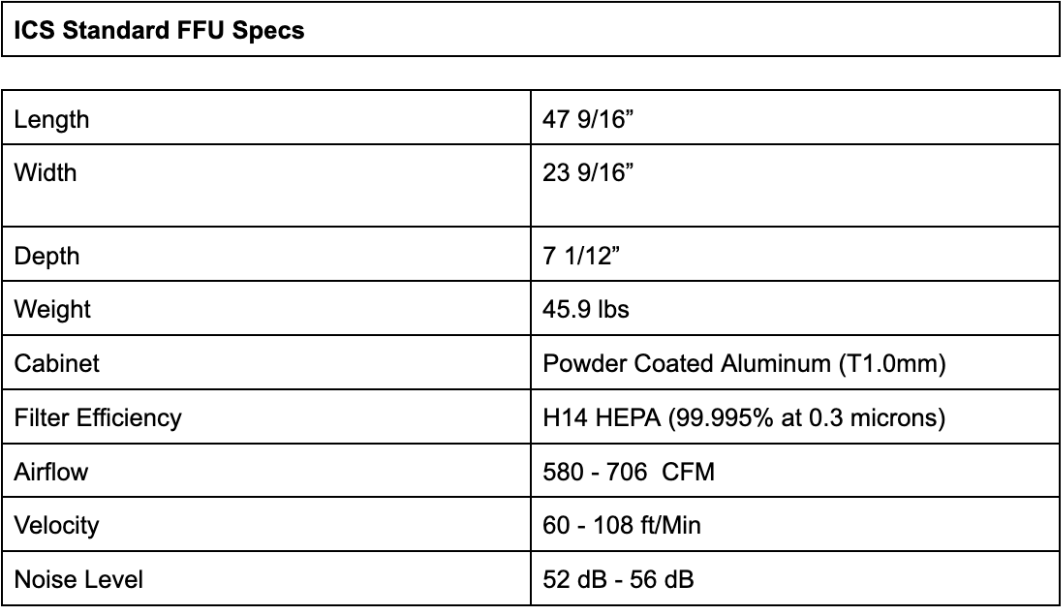
Cleanrooms require constant airflow, making equipment noise a factor. Well-designed FFUs mitigate this issue. Our FFUs are designed to run quietly, and can reduce noise to low 50s dB, roughly the volume of quiet conversation.
Instant Cleanroom Solutions FFU Specifications:
ICS has manufactured standard 2ft x 4ft FFUs in both 120-volt and 220-volt configurations. Like all of ICS’s products, these are kept in stock, and can easily be added to any cleanroom being built or rented by companies. Each unit features a single-control, 3-level rotary switch to adjust fan motor speeds depending on your airflow requirements.
Electrical Configurations:
120V Model (ICS-STD-2X4-120): 120V / 60Hz / 1.4 Amps / 150W. Includes a NEMA 5-15P to IEC320C13 connection and a 1650 RPM motor
220V Model (ICS-STD-2X4-220): 220V / 60Hz / 0.65 Amps / 135W. Features a 3-wire hardwire connection through a 3/8 HALEX Plug Port and a 1600 RPM motor.
Maintenance and Filter Replacement Best Practices:
To keep FFUs operating at peak efficiency, consistent maintenance is required. Over time, as the HEPA filters trap particulate matter, the static pressure drops, requiring the fan motor to work harder to maintain necessary CFM. Facilities should monitor airflow velocity and perform routine tests to check for filter leaks. At the end of a filter lifecycle, FFUs give an advantage. Individual units can be serviced or have filters replaced in the room without shutting down the entire cleanroom system. This minimizes company operation downtimes.
Conclusion:
FFUs are a self contained air filtration unit built with an integrated motor and fan. They are a major component in keeping a cleanroom clean and operational, getting rid of contaminants and replacing and purifying air in a cleanroom. They come with adjustable fan levels, can be bought in multiple electrical configurations, and have many applications, (such as hospital pharmacies, pharmaceutical compound areas, microelectronic facilities, manufacturing plants, and more).
Sources:
American Cleanroom Systems. (n.d.). All about cleanroom HEPA fan filter units. https://www.americancleanrooms.com/all-about-cleanroom-hepa-fan-filter-units/
Cleanrooms By United. (n.d.). Cleanroom HVAC automated control systems. https://www.cleanroomsbyunited.com/resources/automated-control-systems
Pharmaceutical HVAC. (n.d.). Airflow reduction in cleanroom operations. https://www.pharmaceuticalhvac.com/airflow-reduction-in-cleanroom-operations/