


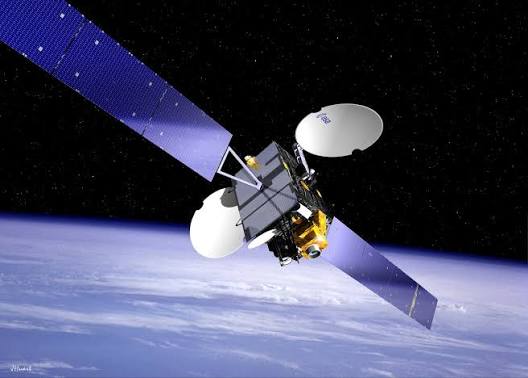
In orbit, spacecraft operate in a microgravity environment where particles don’t settle as they do on Earth, and there is no wind to carry contamination away. A single speck of dust, virtually invisible to the naked eye, can cause a mission-ending catastrophe.
Rocket engines and turbopumps may get the glory, but the foundation of a successful launch happens on the microscopic level before the satellite leaves the ground.
As aerospace manufacturing continues to grow, so does the need for flawless, highly controlled environments.
The Threat: How Tiny Particles Cause Major Failures
Optical Blinding:
In the vacuum of space, outgassing becomes a threat. When non-metal materials such as adhesives and plastics are exposed to a vacuum, they release microscopic molecular vapors. These vapors naturally condense on the coldest surfaces nearby, which are typically the sensitive glass lenses of optical sensors and star trackers. Once they are coated in this molecular film, a multi-million-dollar telescope or navigational sensor can experience degraded imaging performance or, in severe cases, become effectively blinded.
Case Study: The Cassini Spacecraft's "Hazy" Crisis
After the $3.26 billion Cassini-Huygens mission launched in 1997, engineers discovered a hazy, cloudy artifact obscuring images from its Narrow-Angle Camera. Despite the rigorous protocols, microscopic amounts of polymers used in the spacecraft's construction had outgassed in the vacuum of space, condensing directly onto the cold camera lens. Proper assembly and thermal vacuum testing inside a highly controlled, filtered cleanroom on Earth are designed specifically to force this outgassing process before the hardware ever reaches orbit.
Short Circuits and "Tin Whiskers"
Microelectronics in modern satellites are incredibly dense, with semiconductor features measured in nanometers and electrical components packed closely together. Whether it is a microscopic shaving of metal, dust residue, or human skin flakes, particle contamination can float in microgravity environments and settle between exposed pins. When powered on, this creates a "conductive bridge", leading to short circuits in communication or guidance systems.
Case Study: The PanAmSat Galaxy IV Failure:
In May 1998, the Galaxy IV telecommunications satellite, which handled 80% of pager traffic in the US, suddenly began spinning out of control. The failure is frequently cited in discussions of "tin whiskers," which are microscopic, highly conductive crystalline tendrils that grew from the solder and bridged a connection on the primary control processor. The growth of these whiskers was highly accelerated by environmental stressors, specifically humidity and temperature fluctuations during the manufacturing and storage phases. A tightly regulated humidity and climate-controlled cleanroom can prevent environmental stress that triggers this microscopic threat.
Thermal Control Degradation:
Satellites rely on precise surface coatings and specialized paints to withstand the large temperature swings in space. If dust or chemical contaminants settle on the outside of a satellite during assembly, they can alter the absorptivity of the thermal panels. This microscopic layer can cause systems to overheat when exposed to the sun or freeze during an eclipse.
The First Line of Defense: Why "Clean" Isn't Clean Enough
Defining the Standard:
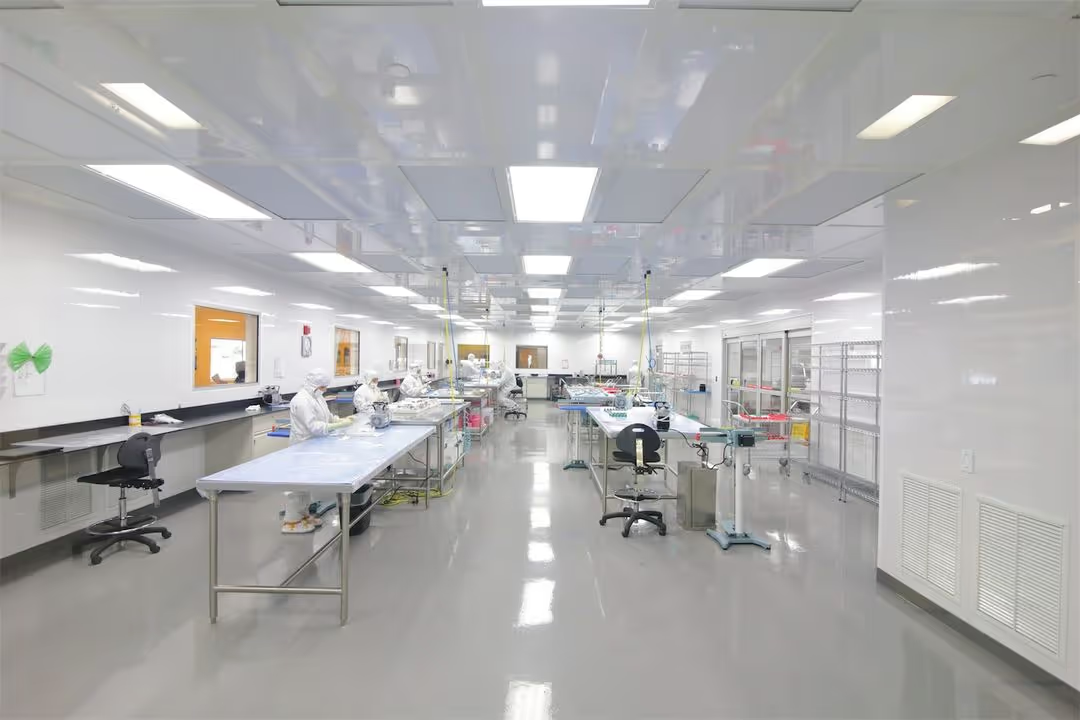
A standard office contains millions of particles per cubic meter of air. As the chart below shows, a cleanroom is a strictly regulated space, and stepping into an ICS ISO Class 4 dramatically reduces airborne particle concentrations compared with conventional indoor environments.
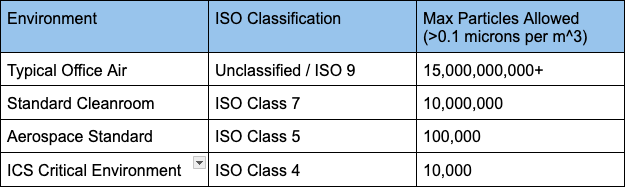
In aerospace, this classification can prevent potentially mission-ending contamination before the hardware leaves the facility.
The Science of Control:
A high-quality cleanroom relies on complex physics to defend against contamination. It requires three important metrics:
- Filtration and Air Pressure: HEPA filters, combined with positive-pressure systems, ensure that when a door opens, air flows outward, helping prevent contaminants from entering the room.
- Humidity Control: Strict regulation prevents dry air conditions that can lead to electrostatic discharge (ESD) as well as excessive moisture that can contribute to corrosion.
- Temperature Stability: Climate controls minimize thermal expansion in sensitive metals and keep technicians from sweating (which increases human particle shedding).
Securing the Future of Space Tech:
There is zero margin for error in the vacuum of space. Missions are becoming more complex and components grow increasingly microscopic. As these advancements continue, the definition of a "controlled environment" must evolve as well. A successful mission is determined by the air quality on the assembly floor.
Whether your operations require a traditional stick-built facility or a customized modular unit, the most important requirement remains absolute environmental cleanliness.
Instant Cleanroom Solutions (ICS) is dedicated to giving aerospace companies the space they need to make new technological advancements. We specialize in getting innovators highly customizable cleanrooms in a quick and efficient way. Instant Cleanroom Solutions ensures temperature, humidity, and ISO classifications are locked in from day one. ICS wants to help eliminate the microscopic threats on Earth and help secure your success in orbit.
References & Standards:
- IEST-STD-CC1246E: Product Cleanliness Levels and Contamination Control Program. Institute of Environmental Sciences and Technology.
- Silver, D. M., et al. "Outgassing Issues and Measurement Protocols for Spacecraft Coatings." SPIE Proceedings.
- NASA-STD-6016: Standard Materials and Processes Requirements for Spacecraft. National Aeronautics and Space Administration (NASA).
- Historical overview of the PanAmSat Galaxy IV satellite failure (IEEE reports on tin-whisker-induced electrical shorts).
- ISO 14644-1: Cleanrooms and Associated Controlled Environments—Part 1: Classification of Air Cleanliness by Particle Concentration. International Organization for Standardization (ISO).
- NASA-HDBK-6022: Handbook for Materials and Processes for Spacecraft. National Aeronautics and Space Administration (NASA).
- NASA Outgassing Database: Materials Outgassing Database for Selecting Spacecraft Materials. National Aeronautics and Space Administration (NASA Goddard Space Flight Center).
- Communication Satellites Telling Us Where They Are (Image Reference). European Space Agency (ESA).